
Imagine your packaging line is running perfectly .
Machines are running.
Workers are doing their jobs.
Orders are being dispatched on time.
Everything looks normal.
But there may be one problem quietly reducing your profit every single day:
Your packages may not all contain exactly the right amount of product.
Suppose your rice mill packs thousands of bags every day. If every bag contains just a few grams more than the target weight, that extra product may look insignificant in one package.
But multiply those few grams by thousands of packages.
Suddenly, a small weighing variation becomes a major product giveaway.
And if some packages are underweight, you have a completely different problem—customer complaints, quality issues and potential compliance concerns.
So, how can a modern processing plant check every package without manually weighing them one by one?
This is where a Checkweigher System becomes an important part of the production line.
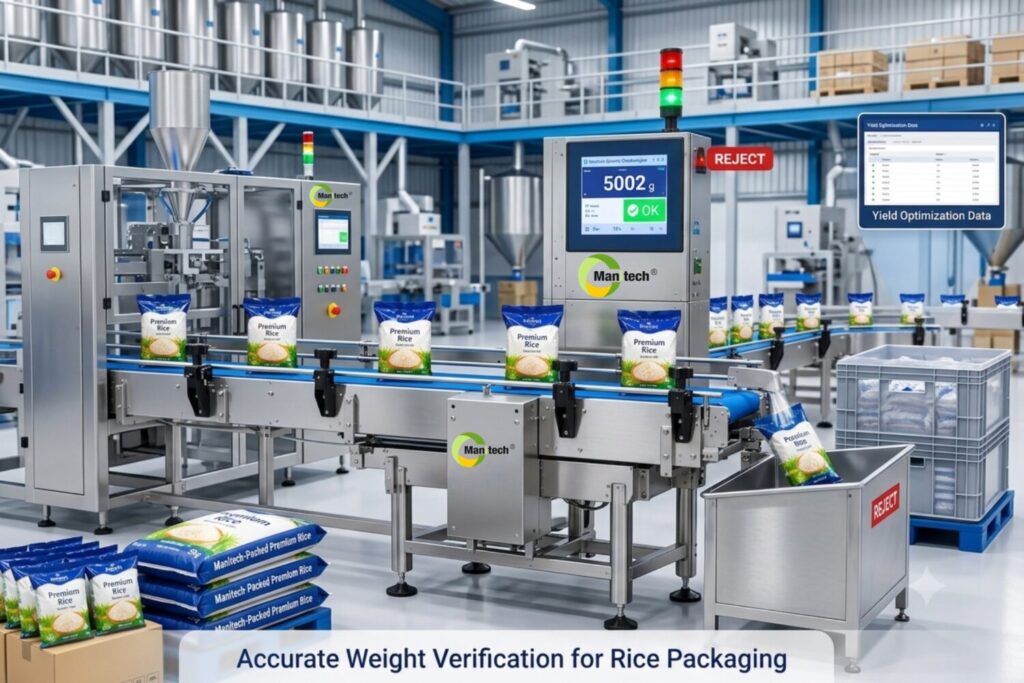
A checkweigher automatically checks the weight of products while they are moving through the production line, helping manufacturers maintain consistent packaging accuracy and identify packages that fall outside the desired weight range.
Manitech provides advanced weighing and inspection solutions designed to help modern food-processing industries improve quality control and packaging efficiency.
The Problem Isn’t Always Your Filling Machine
When a package has the wrong weight, the first thing many manufacturers look at is the filling machine.
But production conditions can change throughout the day.
Product flow may vary.
Machine settings may change.
Vibration can affect equipment.
Different products can behave differently during filling.
Even when the filling machine is properly adjusted, individual packages can still vary.
This creates two possibilities:
Overweight package
You are giving away additional product.
Underweight package
The package may fail to meet the required specification and can lead to customer dissatisfaction.
The real challenge is not simply filling the package.
The challenge is knowing whether every package leaving your production line has the correct weight.
What If You Could Check Every Package Automatically?
Think about manually checking 10,000 packages.
Would you stop the production line every time?
Probably not.
Would you manually weigh every package?
That would be extremely slow and impractical.
This is exactly why automated checkweighing is valuable.
A Checkweigher System continuously weighs products while they move through the production line.
Instead of checking only a small sample, the system can inspect packages continuously and identify products that do not meet the configured weight limits.
That means your production line doesn’t have to choose between speed and quality control.
What Exactly Is a Checkweigher System?
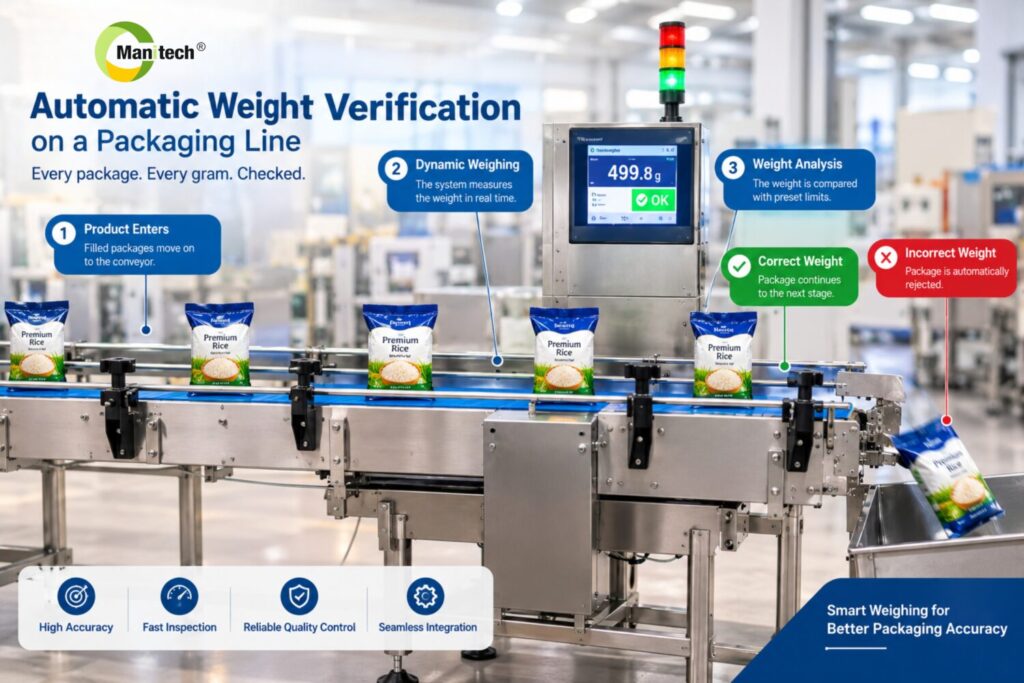
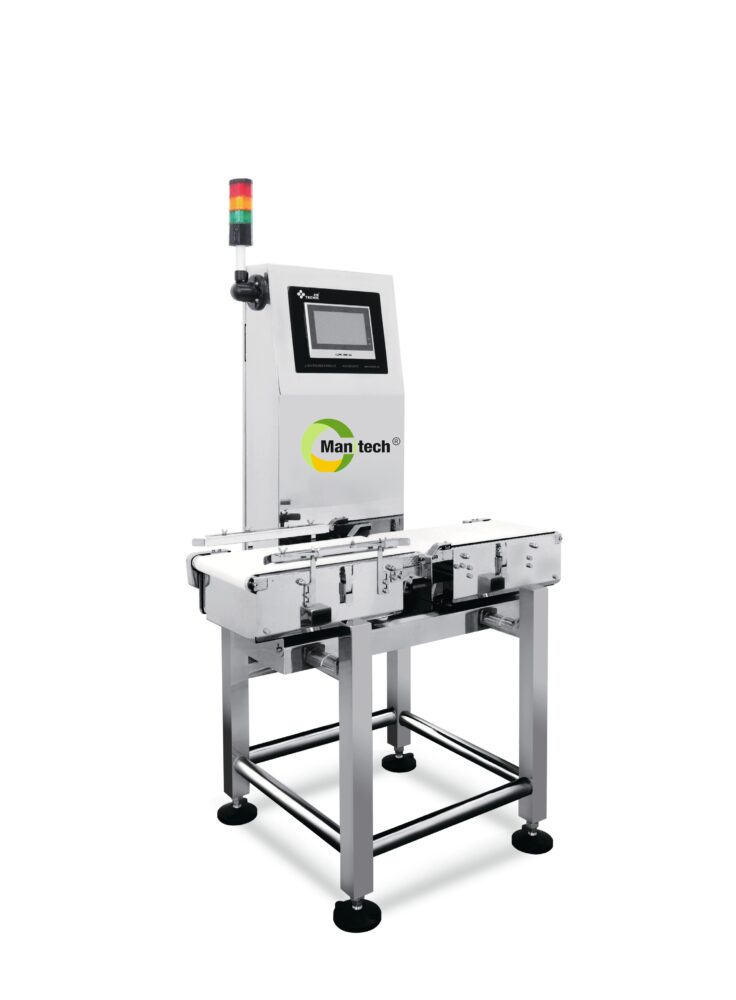
A Checkweigher System is an automated weighing and inspection solution used to verify the weight of individual products or packages during production.
The package moves onto the weighing conveyor, where its weight is measured dynamically.
The system then compares the measured weight with predefined parameters.
If the package meets the required weight range, it continues through the production line.
If it falls outside the acceptable range, the system can trigger an automatic rejection mechanism.
In simple terms:
Pack → Weigh → Check → Accept or Reject
The entire process happens automatically while production continues.
How Does a Checkweigher Actually Work?
Here’s where the technology becomes interesting.
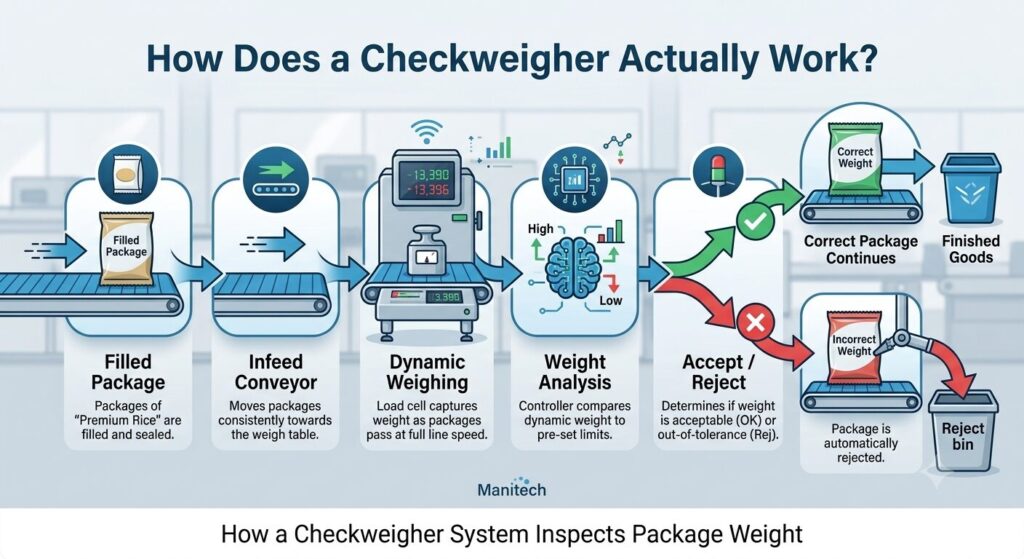
1. The Product Enters
A filled package arrives on the checkweigher conveyor.
2. The Package Is Weighed
The system measures its weight while the package is moving.
3. The Weight Is Compared
The measured value is compared with the configured target and acceptable tolerance.
4. The System Makes a Decision
The package is identified as acceptable or outside the required range.
5. Incorrect Packages Are Rejected
If an automatic reject mechanism is integrated, the incorrect package can be removed from the production flow.
6. Correct Packages Continue
Packages within the required range continue toward the next stage.
This automated process helps manufacturers maintain consistency without manually stopping production for individual weight checks.
Overweight Packages: The Profit You May Not See
Here’s a simple example.
Imagine your production line packs 10,000 packages per day.
If every package contains just 5 grams extra, that’s:
10,000 × 5 grams = 50 kg of extra product per day.
Now think about that over an entire month.
That’s why accurate weighing isn’t only about quality control.
It’s also about controlling product giveaway.
For high-volume manufacturers, small variations can add up quickly.
A Checkweigher helps identify these variations and gives production teams valuable information for maintaining better control over the packaging process.
And What About Underweight Packages?
Overweight packages affect profitability.
Underweight packages can affect something even more important:
Customer trust.
Imagine a customer buying a package labelled with a specific weight and discovering that it contains less product than expected.
One complaint may seem small.
But repeated complaints can affect distributors, retailers and the reputation of the brand.
Automated weight inspection provides an additional quality-control checkpoint before products reach the customer.
Why Rice Mills Can Benefit From Checkweighers
Rice mills today are not simply producing rice.
They are competing on:
- Grain quality
- Packaging quality
- Consistency
- Food safety
- Customer trust
- Export requirements
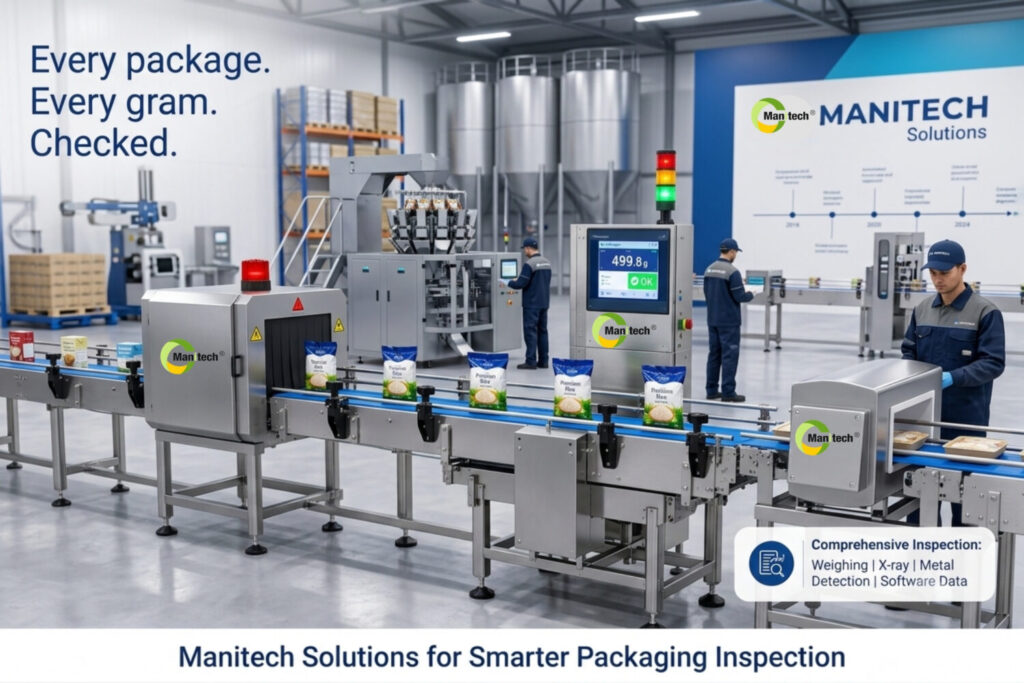
A rice mill may use advanced cleaning equipment and a rice color sorter to improve grain quality, but the job isn’t finished when the rice reaches the packaging stage.
The final package also needs to meet its specified weight.
A Checkweigher can become an important final inspection point before dispatch.
For example:
Rice Processing → Color Sorting → Packaging → Weight Inspection → Dispatch
This creates an additional layer of quality control between production and the customer.
It’s Not Just for Rice
Checkweigher systems can be useful across many industries where products are sold or packed according to weight.
Applications can include:
Rice & Grains
Checking retail and bulk packages.
Pulses
Maintaining consistent dal package weights.
Flour
Inspecting atta, maida and other flour packages.
Spices
Verifying packaged spices before dispatch.
Dry Fruits
Maintaining accurate retail pack weights.
Snacks & Food Products
Checking individual consumer packages.
The right configuration depends on the product, package type, production speed and required accuracy.
What Should You Look For Before Buying a Checkweigher?
Not every production line has the same requirements.
Before selecting a system, manufacturers should consider:
Product Type
Is the product granular, powder-based, solid or packaged food?
Package Weight
What is the typical weight range?
Production Speed
How many packages need to be inspected per minute?
Required Accuracy
What weight tolerance is acceptable?
Reject System
How should incorrect packages be removed?
Production Line Integration
Can the system be integrated smoothly into the existing line?
Understanding these requirements helps manufacturers select a solution suitable for their actual production conditions.
Can a Checkweigher Replace Quality Control?
No.
A Checkweigher is one part of a complete quality-control process.
For a modern food-processing facility, different inspection technologies can perform different jobs.
For example:
Color Sorter → Product appearance and defect sorting
Metal Detector → Metal contamination detection
Checkweigher → Package weight verification
Each technology addresses a different quality-control requirement.
Together, they can create a more comprehensive inspection process.
Why Choose Manitech for Your Inspection Requirements?
At Manitech, our focus is not simply on supplying a machine.
The objective is to help processing industries find practical solutions for their production and quality-control requirements.
Our range of solutions includes technologies for:
- Color sorting
- Metal detection
- Weight inspection
- Food processing
- Packaging quality control
For businesses processing rice, grains, pulses and other food products, choosing the right inspection technology can make a significant difference in production consistency.
Manitech works with customers to understand their application and recommend suitable inspection solutions for their requirements.
The Future of Packaging Is Smarter, Not Just Faster
Production speed will always matter.
But speed without quality control can create problems.
The modern production line needs to be:
Fast + Accurate + Consistent
Automated inspection technologies help manufacturers move toward this goal.
A Checkweigher System provides an automated way to monitor package weight during production, helping manufacturers identify weight variations and maintain greater consistency.
And as food-processing businesses become more automated, intelligent inspection will become an increasingly important part of production.
Before Your Next Production Run, Ask Yourself One Question
Do you really know the weight of every package leaving your production line?
If the answer is based only on occasional manual checking, there may be room to improve your quality-control process.
A modern Checkweigher System can provide continuous weight verification while your production line keeps moving.
For rice mills, food processors and packaging industries, that can mean:
Better accuracy.
Less product giveaway.
More consistent packaging.
Greater customer confidence.
And sometimes, controlling those few extra grams is exactly where better profitability begins.
Explore Manitech’s Complete Range of Products
Looking for more than weight inspection?
Explore Manitech’s range of color sorting, metal detection and inspection solutions for modern food-processing industries.
Have Questions About the Right Machine for Your Production Line?
Contact the Manitech Team for Product Information and Expert Assistance.
Frequently Asked Questions
What is a Checkweigher System?
A Checkweigher System is an automated weighing solution that checks the weight of individual products or packages while they move through a production line.
How does a checkweigher help reduce product giveaway?
It identifies weight variations and helps manufacturers maintain better control over overweight packages, reducing unnecessary product giveaway.
Can checkweighers be used in rice mills?
Yes. Checkweighers can be used for checking the weight of packaged rice and other food products, depending on the package format and production requirements.
What products can be checked using a Checkweigher?
Applications can include rice, pulses, flour, spices, grains, dry fruits, snacks and other packaged products.
Can a Checkweigher automatically reject incorrect packages?
Depending on the system configuration, an automatic reject mechanism can remove packages that fall outside the defined weight limits.
Is a Checkweigher the same as a Metal Detector?
No. A Checkweigher is designed primarily for weight verification, while a metal detector is designed to detect metal contamination. They can be used as complementary inspection technologies on a production line.